
The AI impact on human mind is becoming one of the most debated topics of our generation
Let me ask you something personal.
When was the last time you sat alone, without your phone, without Google, without any app — and just thought? Wrestled with a problem for hours. Made mistakes. Revised your thinking. Arrived at an answer that was entirely, purely yours?
If you are honest, that memory feels distant. And with Artificial Intelligence entering every corner of our lives, it may soon feel ancient.
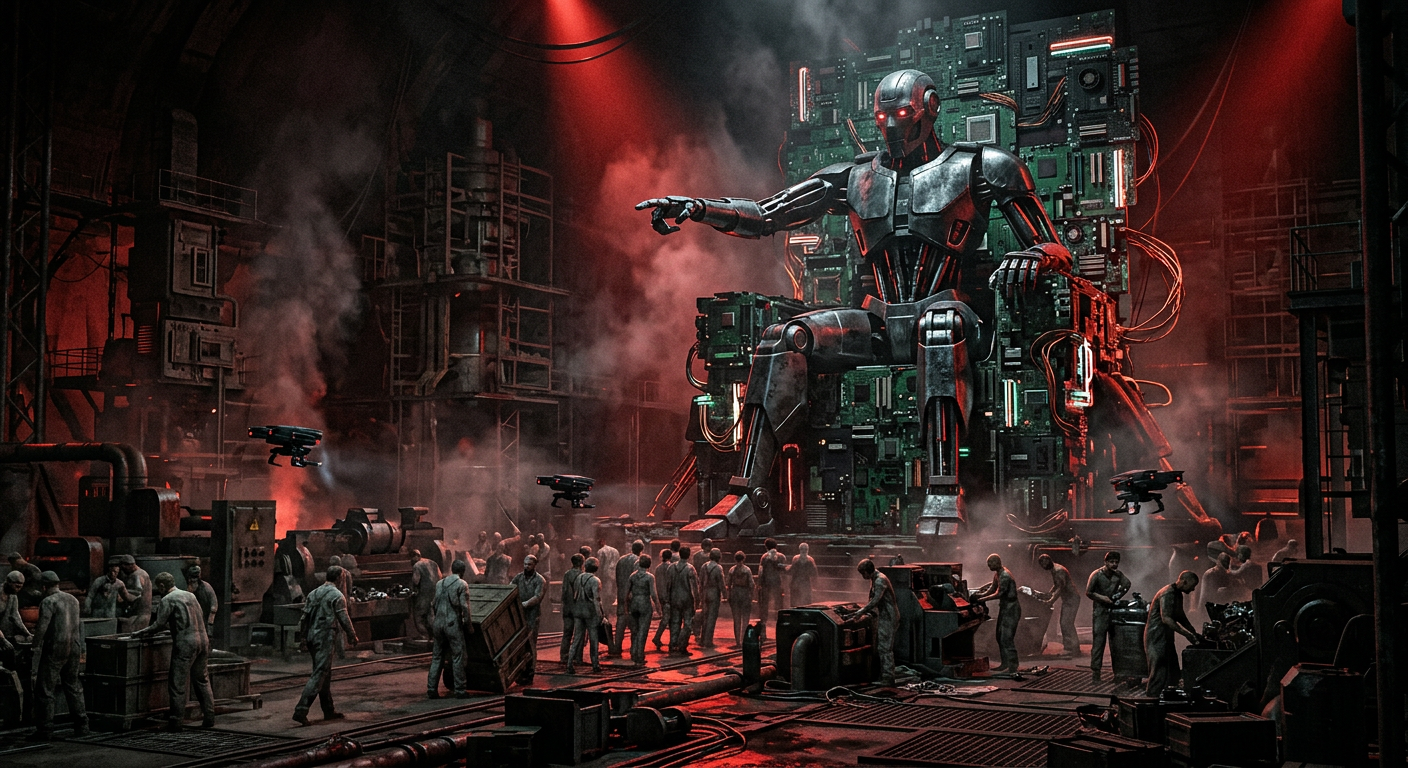
We are living through the most significant transformation in human history since the Industrial Revolution. And unlike that revolution — which replaced human muscle — this one is replacing human mind.
That should make every one of us stop and think. While we still can.
The Fear Is Real — And Justified
Let us not sugarcoat it. AI is taking jobs. Not someday. Now.
A graphic designer who spent five years learning Adobe Photoshop, who charged ₹50,000 for a campaign — is now competing with someone who types a prompt into Midjourney and gets a result in 30 seconds.
A content writer who spent years developing their craft, who understood nuance and voice and tone — is now being replaced by ChatGPT, which produces 1,000 words in under a minute.
A junior accountant who spent three years in college learning balance sheets, auditing, and taxation — is now watching AI tools do in seconds what took them hours.
According to a 2024 Goldman Sachs report, AI could automate tasks that account for 300 million full-time jobs globally. In India specifically, sectors most at risk include:
- BPO and customer service — already being automated rapidly
- Data entry and back-office work
- Basic software coding and testing
- Content writing and translation
- Accounting and financial analysis at entry level
If you are in any of these fields and you are not paying attention — you should be afraid. That fear is not paranoia. It is wisdom.
But Here Is What Nobody Is Talking About
The job loss conversation is loud. But there is a quieter, deeper crisis that barely anyone is discussing.
What is AI doing to the human brain?
Think about this carefully.
A student who once spent three hours solving a mathematics problem — struggling, failing, trying again — was not just solving a problem. Their brain was building neural pathways. Developing patience. Learning that difficulty is not failure. Building the capacity to think deeply.
Now that same student opens ChatGPT, pastes the problem, and gets the answer in 10 seconds.
Problem solved. Brain unstretched.
A researcher who once spent weeks in a library, reading hundreds of papers, synthesising information, forming original hypotheses — was developing one of humanity’s most precious capabilities: deep, original thought.
Now AI can do that research in minutes.
We are outsourcing not just our work — we are outsourcing our thinking.
And like any muscle that stops being used, the human brain’s capacity for deep, original, creative thought will atrophy. Slowly. Quietly. Without us even noticing.
This is the crisis no GDP report will capture. No job loss statistic will measure it. But it may be the most consequential shift of our generation.
The Education System’s Existential Crisis
For centuries, education was built on one fundamental premise: learn a skill, master it, and it will sustain you.
Spend 16 years in school and college. Learn mathematics, language, science, accounting, engineering. Sit through exams that test your memory and your ability to apply knowledge. Get a degree. Get a job.
That entire system is now being questioned — not by philosophers or radicals, but by reality itself.
Today, a Class 12 student with basic prompt engineering skills can produce research-quality analysis that a PhD scholar would have taken months to compile.
A person with no coding background can build a functional website or mobile app using AI tools — something that required years of computer science education just five years ago.
So what exactly are we educating our children for?
The honest answer is: we don’t fully know yet. And that uncertainty is terrifying for parents, students, teachers, and policymakers alike.
India’s education system — already struggling with quality and relevance — now faces an existential question it is completely unprepared to answer.
The Prompt Engineer and the New Hierarchy
Here is something that would have sounded absurd five years ago:
Today, a person who knows how to “talk” to AI effectively — who understands how to frame questions, provide context, and extract high-quality outputs — can outperform specialists who spent decades building their expertise.
This skill has a name: Prompt Engineering.
And it is creating a new hierarchy in the workplace:
- Those who use AI effectively → producing 10x output
- Those who ignore AI → becoming obsolete
- Those who fight AI → already losing
A chartered accountant who uses AI for data analysis, report generation, and pattern recognition — while focusing their human intelligence on strategy, client relationships, and ethical judgment — will thrive.
A chartered accountant who refuses to adapt — will be replaced. Not by AI. But by another chartered accountant who uses AI.
This is the new reality: AI will not replace humans. Humans who use AI will replace humans who don’t.
So Where Are We Headed?
Honestly? Nobody knows for certain. But here is what seems likely:
The jobs that will survive and thrive are those that require:
- Human connection — therapists, teachers, leaders, caregivers
- Physical presence — plumbers, electricians, surgeons, chefs
- Original creativity — true artists, innovators, entrepreneurs
- Ethical judgment — judges, policymakers, spiritual leaders
- AI management — people who build, train, and direct AI systems
The jobs most at risk are those that are:
- Repetitive and rule-based
- Primarily information processing
- Routine analysis and reporting
But here is the deeper question — and this is the one that keeps me up at night:
If AI handles all the repetitive thinking, all the routine analysis, all the information processing — what will humans do with their minds?
Will we use our freed-up mental energy to think bigger, dream deeper, create more beautifully?
Or will we simply… stop thinking?
Will future generations lose the capacity for deep focus, for sitting with a difficult problem, for the particular satisfaction of figuring something out the hard way?
History suggests both outcomes are possible. The printing press democratised knowledge but also created propaganda. The internet connected humanity but also fragmented attention. Every powerful tool cuts both ways.
What You Should Do — Right Now
Do not wait for the world to figure this out. Here is a practical path forward:
1. Learn to use AI — immediately
Start with ChatGPT, Gemini, or Claude. Use them daily. Learn prompt engineering. This is the most valuable skill of the next decade.
2. Protect your deep thinking time
Deliberately spend time solving problems without AI. Read books. Write by hand. Think without assistance. Exercise your brain the old-fashioned way — because that capacity, once lost, is very hard to rebuild.
3. Shift toward human skills
Invest in communication, empathy, leadership, and creativity. These are the skills AI cannot replicate — at least not yet.
4. Teach your children differently
The goal of education can no longer be memorisation and routine problem-solving. It must be curiosity, critical thinking, and the ability to ask the right questions — because in an AI world, the quality of your questions matters more than the quantity of your answers.
5. Stay curious — stay human
The greatest risk of the AI age is not unemployment. It is intellectual surrender — the quiet decision to let machines do our thinking for us. Resist it. Your mind is the one thing no algorithm can truly replace.
The Angel and the Devil
AI is both — simultaneously.
The devil takes your job, weakens your mind, disrupts your education, and creates inequality between those who adapt and those who don’t.
The angel gives you superpowers — the ability to research, create, analyse, and produce at a scale previously impossible for a single human being.
Which one shows up in your life depends entirely on one thing: your choice.
Use AI as a tool — and you become more powerful than any generation before you.
Surrender to AI as a replacement — and you become less than what you were.
India has always been a civilisation that valued wisdom — not just knowledge. Gyaan, not just jaankari. In the age of artificial intelligence, that distinction has never mattered more.
The machines can process information. Only you can find meaning.
इस लेख को share करें — क्योंकि यह सवाल हर भारतीय के लिए है, हर उम्र के लिए है।
AI एक औज़ार है — इसके मालिक बनो, इसके गुलाम नहीं।